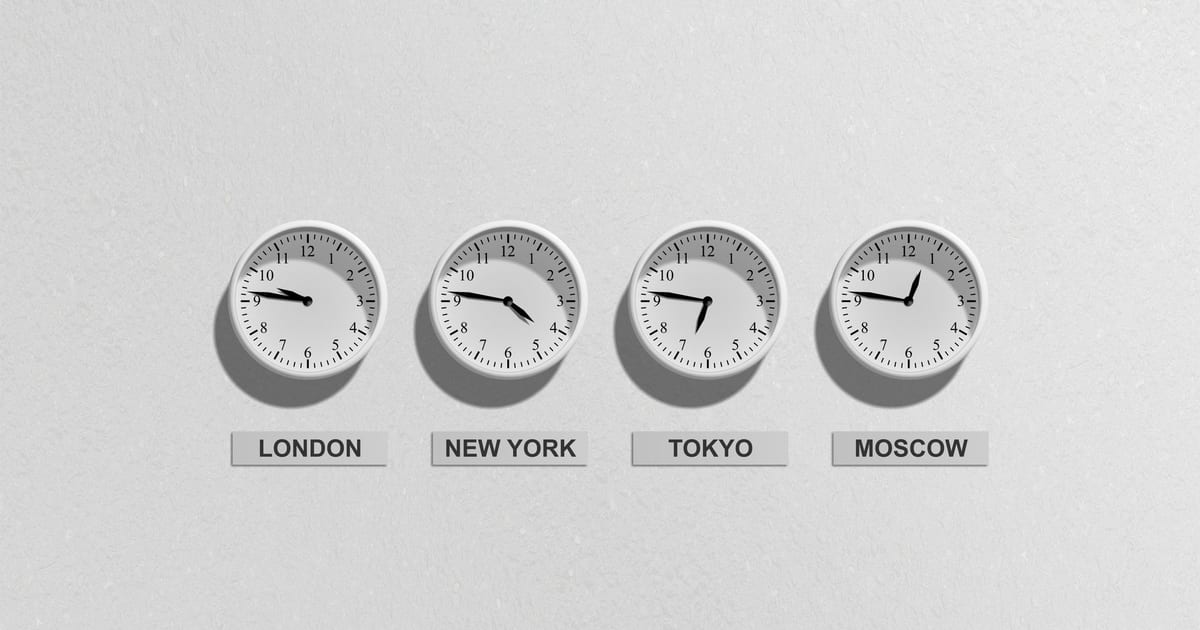
Every offshore vendor's website says the same thing: "3–4 hours of overlap with your team." Almost none of them tell you which hours, whose evening pays for them, or what happens at 2 a.m. when a deploy fails.
The overlap number is not the point. A team with two well-run hours beats a team with five unstructured ones. What determines whether offshore delivery works is the operating model sitting on top of the overlap: what gets decided live, what gets handed over asynchronously, and who is reachable when something breaks.
Here is the actual arithmetic for each US timezone, and the model we run against it.
TL;DR
- India is UTC+5:30 with no daylight saving. The gap to US Eastern is 9.5 hours in summer and 10.5 in winter, so your overlap window moves twice a year even though India's clock never changes.
- US Eastern gets a comfortable 3 hours (09:00–12:00 ET) if the India team works to 21:30 IST. US Pacific gets about 2 hours and someone has to work late for them.
- The UK is the easy case — 5+ hours of natural overlap, effectively a full working day.
- Overlap hours belong in the contract, not the pitch deck. "We're flexible on timings" means nobody is accountable at 6 p.m. IST.
- The failure mode is never skill. It is a decision that waits 19 hours because nobody could approve it, or an incident routed to a team that logged off eight hours earlier.
The actual overlap windows
India runs on IST, UTC+5:30, and does not observe daylight saving. The US does. That means the gap changes twice a year while India's clock stays still — a detail that quietly breaks recurring calendar invites every March and November.
These are the summer (US daylight time) figures:
| Your location | Gap to IST | Overlap window (US local) | Same window in IST | Real overlap |
|---|---|---|---|---|
| US Eastern (EDT) | 9.5 hrs | 09:00 – 12:00 | 18:30 – 21:30 | ~3 hrs |
| US Central (CDT) | 10.5 hrs | 09:00 – 11:00 | 19:30 – 21:30 | ~2 hrs |
| US Mountain (MDT) | 11.5 hrs | 08:30 – 10:00 | 20:00 – 21:30 | ~1.5 hrs |
| US Pacific (PDT) | 12.5 hrs | 09:00 – 11:00 | 21:30 – 23:30 | ~2 hrs |
| UK (BST) | 4.5 hrs | 09:00 – 14:30 | 13:30 – 19:00 | ~5.5 hrs |
In US winter, add an hour to every gap: Eastern becomes 10.5 hours from IST, Pacific 13.5. The India-side window shifts an hour later, which is why a Pacific engagement that worked in October starts hurting in December.
Read the IST column honestly. A 3-hour Eastern overlap requires the India team to work until 21:30 IST — that is 9:30 in the evening. A Pacific overlap runs to 23:30 IST. That is not a rota anyone sustains for a year without either burning out or quietly drifting back to normal hours around month four. If a vendor promises Pacific overlap without telling you what it costs their team, they are describing a plan that expires.
What the overlap is for
Three hours is not enough to work together. It is enough to make decisions together, which is a different job.
Use the window for the things that block if they wait:
- Decisions requiring a human yes — scope calls, priority changes, anything with a trade-off.
- Ambiguity resolution — the ticket that could mean two things. Five minutes live saves a day of the wrong build.
- Demos of anything visual — asynchronous screenshots generate more questions than they answer.
- Escalations and blockers — surfaced in the window, not logged for tomorrow.
Everything else belongs in the other 21 hours: writing code, reviewing PRs, running tests, updating tickets, writing the handover. If your overlap window is being spent on status updates that a written summary would cover, you are burning your scarcest resource on your cheapest activity.
The handover, in writing
The single highest-leverage artefact in offshore delivery is a written handover at the end of each side's day. Not a status meeting. A document.
End of India day (~19:00 IST), the India lead writes:
- What shipped, with PR links.
- What is blocked, and the specific decision needed to unblock it.
- What will be picked up tomorrow, in priority order.
- Anything the US side must action before India's morning.
End of US day, the US lead responds to items 2 and 4.
That is the whole ritual. It works because item 2 forces the blocker into a form someone can answer without a meeting, and item 4 creates a short, explicit list rather than a vague expectation. Teams that skip this replace it with a daily call that eats the overlap window and still leaves decisions pending.
Ceremonies that survive the gap
A workable weekly rhythm for a US East engagement:
| Ceremony | When (IST) | When (ET) | Duration |
|---|---|---|---|
| Daily standup | 18:45 | 09:15 | 15 min |
| Handover doc posted | 19:00 | 09:30 | Async |
| Sprint planning (Mon) | 19:00 | 09:30 | 60 min |
| Demo + retro (alt. Thu) | 19:00 | 09:30 | 45 min |
| Ad-hoc decision slot | 20:00–21:00 | 10:30–11:30 | As needed |
Note what is missing: no daily call longer than 15 minutes, and no ceremony that requires the India team past 21:30 IST on a routine basis. The late slot exists for genuine decisions, and it should sit empty most days. If it is full every day, the handover document is not doing its job.
Escalation and on-call
This is where offshore engagements actually fail, and it has nothing to do with the working day.
Production breaks at 02:00 ET. That is 11:30 IST, the middle of India's working day, which is the good case — you have a full team awake while your own office sleeps. The bad case is the reverse: something breaks at 04:00 IST, which is 18:30 the previous evening in New York. The India team is asleep, the US team has just logged off, and both sides assumed the other was watching.
Specify three things before the engagement starts:
- Who holds the pager in each window, named, with a phone number that works.
- The severity ladder — what constitutes a wake-someone-up incident versus a wait-until-morning one. Write examples, not definitions.
- The maximum acknowledgement time per severity, and what happens when it is missed.
If the work involves production infrastructure, price the rota explicitly. On-call is a rate driver, not a favour, and we cover what it does to contractor pricing in the DevOps engineer rate benchmark.
What to put in the contract
Vendors will agree to overlap in conversation and stay silent about it in the SOW. Get these written:
- Committed overlap hours, stated in both timezones, with the DST shift acknowledged.
- Named individuals, not "a team of five". You are buying specific people.
- The handover artefact as a deliverable, with a defined format.
- Escalation contacts and acknowledgement SLAs.
- Notice period for rota changes — so the engineer who does your evenings is not silently swapped in month three.
A partner who resists writing overlap into the contract is telling you it is aspirational. That is the single most useful signal available during vendor selection, and it costs nothing to test. For the wider vendor-comparison view, see nearshore vs offshore development and our rate benchmark by country.
When offshore is the wrong answer
Honest cases where the timezone gap is not worth managing:
- Requirements are still moving weekly. Offshore amplifies specification churn — every ambiguity costs a full day round trip. Settle the scope first.
- The work is genuinely Pacific-hours interactive — live pair programming with a US West team, or an on-site-adjacent role. The 23:30 IST window will not hold.
- You need one contractor for three weeks. The handover discipline has setup cost, and it does not amortise over a short engagement.
Offshore works best on defined scope with a stable backlog, which is also when the daily decision load is low enough that three hours is plenty.
FAQ
How many hours does India actually overlap with US business hours? About 3 hours with US Eastern (09:00–12:00 ET, 18:30–21:30 IST) and roughly 2 with Pacific, and both require the India team to work into their evening. The UK gets 5+ hours naturally. In US winter, every gap grows by an hour because India does not observe daylight saving.
Does India observe daylight saving time? No. India stays on IST (UTC+5:30) year-round, so the gap to US and UK teams changes twice a year from their side only. Recurring meetings need checking each March and November.
What is the follow-the-sun model? Work handed from one timezone to the next so progress continues around the clock. It only works with a disciplined written handover — without it, you get duplicated effort and decisions waiting a full cycle rather than 24-hour productivity.
How do we stop decisions waiting a full day? Put every blocker into the end-of-day handover as a specific question with options, not a status note. Most decisions can then be answered asynchronously. Reserve the live window for trade-offs that genuinely need discussion.
Should overlap hours be in the contract? Yes, stated in both timezones with named individuals and the DST shift acknowledged. A vendor who will only commit verbally has given you useful information about how month four will go.
Is the timezone gap a reason to choose nearshore instead? Sometimes. Latin America offers near-full US overlap at a higher rate. The trade-off is cost against convenience, and it turns on how many live decisions your work generates per week rather than on the timezone number itself.
Evaluating an offshore team for a US or UK roadmap? First Bridge Consulting places contract engineers from India with overlap hours, named individuals and escalation paths written into the engagement — and we will tell you plainly when your requirements are too unsettled for offshore to be the cheaper answer. See our contract staffing service, or get a staffing proposal in 48 hours →
Related reading: Nearshore vs Offshore Development · Staff Augmentation Companies in India · Offshore Developer Rates by Country 2026 · Contract Staffing services
Sources
Timezone arithmetic in this post is calculated from IST (UTC+5:30) against US daylight and standard time, and is verifiable against any timezone converter. The industry context below is published by others.
- Time zone advantages: turning the India-US gap into an edge — Your Team in India (typical 3–4 hour overlap windows)
- Tips to handle time zone differences with offshore teams — The Scalers (handover practice)
- Managing time zone differences with India: a 2026 guide — SCT (follow-the-sun operating patterns)